Showing posts with label Reading. Show all posts
Showing posts with label Reading. Show all posts
Sunday, December 15, 2013
Main Idea lesson Plans and Freebies!
Teaching students to identify the main idea and supporting details in a story can be very difficult. In the past, this was always a weak area for my students. Not this year! After taking our school benchmark assessments my students scored really high on finding the main idea and details. If finding the main idea has been a struggle for your students, maybe some of these activities below will help your kiddos understand. Below is an outline of a few of my lessons.
Day 1- I used a power point that I had borrowed from a friend to teach students that a good paragraph consists of one main idea. It includes a topic sentence that states this big idea. Then the author supports this big idea with three major details. These three major details are then followed up by a minor detail. Finally the paragraph ends with a closure sentence or a transition sentence to the next paragraph. We took Cornel Notes from the Power Point.
Day 2- We talked about stated and implied main ideas. I showed another power point and students added to their Cornell notes. Then, we used a set of main idea task cards I had purchased from TPT. These cards have both stated and implied main ideas. My students really enjoyed working in groups and discussing what they thought the main idea and details were.

 Day 3- One day it finally dawned on me that my students could not identify the main idea of a paragraph or story because they did not understand the organization and structure of paragraphs. Since reading and writing are reciprocal, I decided to start teaching my students about the organization of paragraphs. I created a graphic organizer that broke the paragraph into 8 sentences. After modeling how each paragraph has a topic sentence, several major details and then minor details to support the major details it finally clicked. * graphic organizer freebie at the bottom of the page.
Day 4- Then, we looked at nonfiction text on Reading A-Z and used the same graphic organizer to analyze each paragraph within the story. I projected the story on the Smart Board and then had the students transfer the sentences from the story onto the graphic organizer.
Day 5- I put students in pairs and told them to think about a nonfiction topic that they knew a lot about. Then, I gave them 8 sentence strips. They were to use one strip for each part of the graphic organizer. Finally, we taped the 8 sentence strips together to make our paragraph.

Day 6- During Writer's Workshop, I had students use the graphic organizer to create an introductory paragraph for their paper. All of the students were going to write about a field trip that we had just went on the week before. I told them that the intro paragraph should discuss the moment they got off the bus and what they saw and their initial thoughts. The paragraphs were amazing. We spent the next week and a half during Writer's Workshop using the same approach for each paragraph of their paper.
Review- This week we are going to continue the unit by playing my Christmas I Have, Who Has Main Idea game.

Day 1- I used a power point that I had borrowed from a friend to teach students that a good paragraph consists of one main idea. It includes a topic sentence that states this big idea. Then the author supports this big idea with three major details. These three major details are then followed up by a minor detail. Finally the paragraph ends with a closure sentence or a transition sentence to the next paragraph. We took Cornel Notes from the Power Point.
Day 2- We talked about stated and implied main ideas. I showed another power point and students added to their Cornell notes. Then, we used a set of main idea task cards I had purchased from TPT. These cards have both stated and implied main ideas. My students really enjoyed working in groups and discussing what they thought the main idea and details were.

Day 4- Then, we looked at nonfiction text on Reading A-Z and used the same graphic organizer to analyze each paragraph within the story. I projected the story on the Smart Board and then had the students transfer the sentences from the story onto the graphic organizer.
Day 5- I put students in pairs and told them to think about a nonfiction topic that they knew a lot about. Then, I gave them 8 sentence strips. They were to use one strip for each part of the graphic organizer. Finally, we taped the 8 sentence strips together to make our paragraph.
Day 6- During Writer's Workshop, I had students use the graphic organizer to create an introductory paragraph for their paper. All of the students were going to write about a field trip that we had just went on the week before. I told them that the intro paragraph should discuss the moment they got off the bus and what they saw and their initial thoughts. The paragraphs were amazing. We spent the next week and a half during Writer's Workshop using the same approach for each paragraph of their paper.
Review- This week we are going to continue the unit by playing my Christmas I Have, Who Has Main Idea game.
Click the picture below for a freebie of my graphic organizer


Sunday, July 21, 2013
Integrating Science and SS
While attending a workshop a few weeks back. I spoke with a fellow teacher and she was showing me a subscription she had to Kids Discover. I had never seen this wonderful magazine before, but thought it would be a great way to integrate science and SS while teaching reading.


 Let's pretend you are a fifth grade teacher and you are teaching Structures and Functions of Living Organisms. How awesome would it be to place several copies of each of these magazines at a table and have students Jig Saw what they have learned. Better yet, during reader's workshop you could use these magazines to teach nonfiction text features and text structures.


One of the complaints I have heard from my fellow teacher friends is they are struggling to finding good materials to teach the science and SS standards partially due to sharing kits. I think these magazines would be a great purchase for a grade level.
This magazine also has lots of info-graphics which is perfect for preparing for common core testing. Using these often in the classroom will help students see the importance of reading the graphics and looking at the diagrams not just the text in the paragraphs.

The best part about these magazines is you can buy individual magazines or subscribe to all. To view a sample edition or to look through their inventory click here. I think it is important to note that this is not a sponsored post. I have no affiliation with Kids Discover.


One of the complaints I have heard from my fellow teacher friends is they are struggling to finding good materials to teach the science and SS standards partially due to sharing kits. I think these magazines would be a great purchase for a grade level.
This magazine also has lots of info-graphics which is perfect for preparing for common core testing. Using these often in the classroom will help students see the importance of reading the graphics and looking at the diagrams not just the text in the paragraphs.
* All images are property of Kidsdiscover.com
Follow my blog with Bloglovin
Follow my blog with Bloglovin
Monday, April 22, 2013
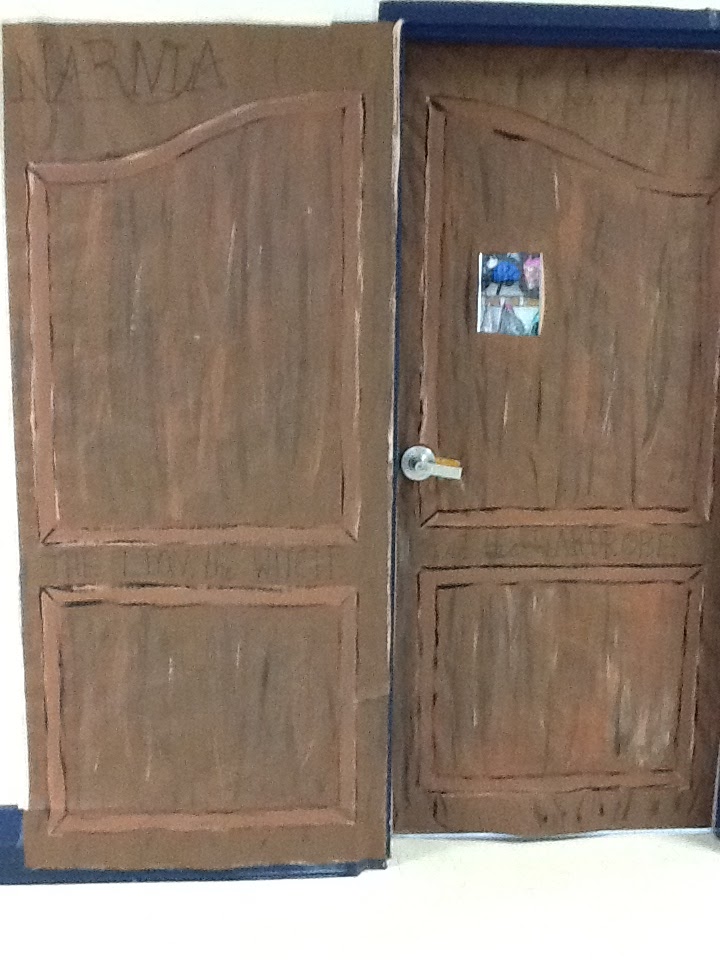
Welcome to Narnia
This week we are continuing to read The Lion, the Witch and the Wardrobe and I wanted to share with you how I transformed our classroom door. This way when students enter the classroom they are actually entering Narnia.
I wanted to put lamp posts up in the classroom and decorate the room in a winter theme, but I have been so busy that this is all I have done so far.
My students have been working really hard this week to create poems for the story also. I have taken some of the poems they have made and blown them up on our poster maker. The kids are very excited to see their posters hanging up outside our classroom.
Friday, April 5, 2013
Teaching Fluency Using Poetry- GIVEAWAY Ends April 12th
Ok Friends, it is time for a super GIVEAWAY! I have been asked time and time again about a resource I use to teach fluency. I know that many of you are familiar with a post I wrote a while back about how I use Shannon Dipple's (of Primary Education Oasis) Teaching Poetry for Fluency and Comprehension.

 I have received so much feedback about this product that Shannon and I have decided to give away one copy. This giveaway includes not just one book, but actually three and they are huge! It is a great resource and comes with all the poems, activities and skill sheets you will need to teach either a small fluency group or even use whole group. Click here to see a free sample of the book.


See examples from her book below!
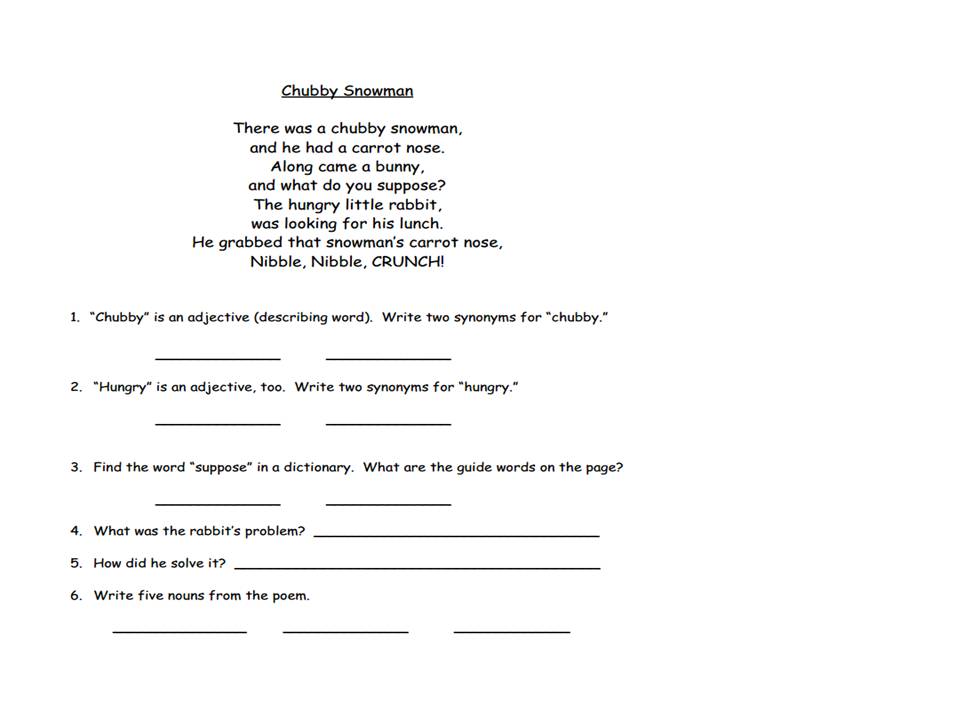

SO HOW DO YOU WIN IT?-IT IS AS EASY AS 1, 2, 3 !
All you have to do to be entered in this drawing is:
1.Click the picture above and repin it
2. Follow my Pinterest account ! (Leave a comment saying you did so)
3. Check back next Friday, April 12th to see if you won!
The Phonics Dance
After leaving second grade I thought I would never use Virginia Dowd's The Phonics Dance again. Boy was I wrong! Friends, my fourth graders still struggle with decoding some of their words because the only word attack strategy they are familiar with is to sound it out or use context clues. What about words that are not phonetically correct? How are these students suppose to attack these words? The answer... they can't! We have to teach them.
Everyday while my students are in their centers I rotate through the classroom and confer with readers. I use my Reader's Workshop binder to record all kinds of information about what I hear and what I see. Most of the things I hear and see with my fourth graders fluency wise are: decoding problems, intonation and accuracy. I use these notes to help set up my intervention groups. After reading with each student I observe common patterns in their weaknesses. One day after listing to my students read, I decided to pull the students who I had observed with decoding problems. I showed them each of the The Phonics Dance cards and asked them to tell me the sound that the letter combination made. I was shocked! They had no clue! There was a long pause and then /a/ /u/. The next day, I assessed each letter combination they knew and did not know and we went to work.
First students learned The Phonics Dance by singing, chanting rhymes and dancing for common blend, digraphs and diphthongs like au, aw, ough, ing, th and ou. I did not introduce one card a day, but more like four or five since they were older students. The best part about The Phonics Dance is that it is a spiral review. After practicing these sounds in isolation we began working on placing them within words and "hunking" and "chunking". When students are "hunking" or chunking " they are training themselves to look at letter combinations and the sounds these combinations make instead of looking at each letter individually.
Finally, it was time for reading paragraphs with these letter combinations hidden within the words. This was not an overnight success There were many days in which I sat with a whiteboard beside a child as they were reading. Once they came to a word they could not sound out I would write it on the white board. Then we would "hunk" and "chunk" the word together. Now the responsibility has shifted to the students and they record unknown words on their board and "hunk" and "chunk" it themselves. To me the board was a way to show a "think-aloud" strategy for them. Eventually, the board will be gone and they will be much more fluent readers. These students are now responsible for looking for the "hunks" and "chunks" within their spelling words and even creating new words that have the same weekly spelling pattern.
As you can see The Phonics Dance can be used with any grade. After all this is what intervention is about. Finding out what individual students need and making sure they get it! If you would like to see a free sample of what you will get when you purchase The Phonics Dance click here.
Everyday while my students are in their centers I rotate through the classroom and confer with readers. I use my Reader's Workshop binder to record all kinds of information about what I hear and what I see. Most of the things I hear and see with my fourth graders fluency wise are: decoding problems, intonation and accuracy. I use these notes to help set up my intervention groups. After reading with each student I observe common patterns in their weaknesses. One day after listing to my students read, I decided to pull the students who I had observed with decoding problems. I showed them each of the The Phonics Dance cards and asked them to tell me the sound that the letter combination made. I was shocked! They had no clue! There was a long pause and then /a/ /u/. The next day, I assessed each letter combination they knew and did not know and we went to work.
First students learned The Phonics Dance by singing, chanting rhymes and dancing for common blend, digraphs and diphthongs like au, aw, ough, ing, th and ou. I did not introduce one card a day, but more like four or five since they were older students. The best part about The Phonics Dance is that it is a spiral review. After practicing these sounds in isolation we began working on placing them within words and "hunking" and "chunking". When students are "hunking" or chunking " they are training themselves to look at letter combinations and the sounds these combinations make instead of looking at each letter individually.

Finally, it was time for reading paragraphs with these letter combinations hidden within the words. This was not an overnight success There were many days in which I sat with a whiteboard beside a child as they were reading. Once they came to a word they could not sound out I would write it on the white board. Then we would "hunk" and "chunk" the word together. Now the responsibility has shifted to the students and they record unknown words on their board and "hunk" and "chunk" it themselves. To me the board was a way to show a "think-aloud" strategy for them. Eventually, the board will be gone and they will be much more fluent readers. These students are now responsible for looking for the "hunks" and "chunks" within their spelling words and even creating new words that have the same weekly spelling pattern.
As you can see The Phonics Dance can be used with any grade. After all this is what intervention is about. Finding out what individual students need and making sure they get it! If you would like to see a free sample of what you will get when you purchase The Phonics Dance click here.
Tuesday, April 2, 2013
Motivating Unmotivated Readers
Every year one of my tasks as a teacher is to find those unmotivated readers and reignite their passion for reading. I find that as students progress through elementary school their love for reading dwindles and therefore the gap between those who read well and those who struggle with reading widen.Below is a list of things that I have done in the past that I have found beneficial. I also suggest reading Steven Layne's book if you are interested in learning more about this topic. He is a dynamic speaker and very motivating!


- Interest inventories- I pass these out to students at the beginning of the year and then again after Christmas. I ask them to jot down some of their hobbies, favorite sports and previously read books. This allows me to find out what interests them and then I always check out a stack of books for each child based on their inventory. Students are very possessive about the books I have given them and they always seem to enjoy them.
- Put a book in a child's hand- Last month I had a reader who would never complete any book. He wasn't motivated to read and spent so much time shopping in the classroom library.Then, I found a book that I thought he would adore (Chasing Lincoln's Killer) and said, "When I saw this book, I knew you would love it. I grabbed it for you because I knew all the other students would swipe it off the shelf before you could get to it." No kidding, he had read over half the book by lunch that day!
- Book Talks- I am in the process of doing one of these now. Recently, I attended a conference in which Steven Layne described how each teacher is some child's favorite. He told us about the power that teachers have on students choice in books. He suggested having teacher do book talks for the school in which they really pumped up a book. I am planning on doing a book talk with the book Mergers. I am going to put it in a small grill and wheel it into the classroom like Dr. Layne suggests. I am going to put a sign on the grill that says, Mrs. McCumbee's Sizzling Book Pick.
- Create a bulletin board display that has pictures of all the teachers on a grade level and then the cover of their favorite book. I also think this would be great school initiative! I would love to see outside each teacher's classroom a copy of their favorite book.
- Book Trailers- Have students create book trailers for their favorite books. Then they can show the trailers to their classmates.
- Bulletin Board Displays with book recommendation tags. Each time a student reads a really great book they could fill out a tag to add to the board.
- Introduce books that are powerful, but that they have not heard of before. For example, my kids are very familiar with the Battle of the Books list and will likely read these on their own.For my gifted readers, I like to find books that are outside of what their friends are reading to encourage more reading. Like This Side of Paradise.
I would love to hear about other ways you motivate readers.
Friday, March 29, 2013
Battle of the Books


Since my students were finished with their chapter books each group worked on a project that had them analyze the main characters. I had one student from each group trace their hands and feet onto construction paper. Then, they had to draw the main character for their book. Around the picture they wrote qualities of the characters and things they learned about them throughout the story. Then, they looked for parts in the book where the author allowed the main character to speak. This is generally when you learn important information about the way the character thinks. They also found examples within the book when other characters reacted to the main character. This allows the reader to learn more about the character as well. I am thrilled with how these projects turned out. I think the characters are spot on!

Wednesday, March 20, 2013
Time-On-Task
Now that my students have been using their roles within their reading groups for a few months, I have noticed several things. One - most of the students are working hard and doing their best, but I still have a few who can't seem to get it together. Two - the students who are on-task spend valuable time redirecting the other students.
Yesterday, I pulled my class to the carpet and we discussed what each role is and I modeled what a guided reading group should look like. I chose five other students to model a guided reading group with me and I gave them each a job. As a group we talked about what the roles were and how to do them to the best of our ability.
Today as my students entered the class, I timed how long it took before every child in the class had sat down and began their morning work. I was shocked that it took 15 minutes. I also wrote down notes about what early finishers did. Then it was time for a group discussion. I told the class today I observed each students time-on-task, or T.O.T (as my students have named it). I told them the day before I had video taped the class during their guided reading groups and I saw some students who were not on the same page as the rest of the group. I also saw students wasting time looking for supplies and many other things I was not pleased with. We had a good discussion about how much time we had lost yesterday and how that would never happen again. After going through all the procedures for entering the room and what to do when we finish early, I had the students go to their guided reading groups.
While groups began reading their chapter books, I sat out a flip camera to record each group. I could see the shock on the students faces and I walked around and set them up. After the groups had finished, I told them from now on each guided reading group would be recorded. I decided periodically I would pull these groups and let them watch their group. I have made a rubric for them to use to evaluate their time-on-task. I was so impressed at how much better they work. I was also impressed by how I was able to easily work with my group without having to worry about students who were off-task.
I created a poster today I am going to use to record students who were caught exemplifying what great time-on-task looks like. If you would like a free copy click the picture below or head on over to my professional development page. This page has tons of great free downloads!

Yesterday, I pulled my class to the carpet and we discussed what each role is and I modeled what a guided reading group should look like. I chose five other students to model a guided reading group with me and I gave them each a job. As a group we talked about what the roles were and how to do them to the best of our ability.
Today as my students entered the class, I timed how long it took before every child in the class had sat down and began their morning work. I was shocked that it took 15 minutes. I also wrote down notes about what early finishers did. Then it was time for a group discussion. I told the class today I observed each students time-on-task, or T.O.T (as my students have named it). I told them the day before I had video taped the class during their guided reading groups and I saw some students who were not on the same page as the rest of the group. I also saw students wasting time looking for supplies and many other things I was not pleased with. We had a good discussion about how much time we had lost yesterday and how that would never happen again. After going through all the procedures for entering the room and what to do when we finish early, I had the students go to their guided reading groups.
While groups began reading their chapter books, I sat out a flip camera to record each group. I could see the shock on the students faces and I walked around and set them up. After the groups had finished, I told them from now on each guided reading group would be recorded. I decided periodically I would pull these groups and let them watch their group. I have made a rubric for them to use to evaluate their time-on-task. I was so impressed at how much better they work. I was also impressed by how I was able to easily work with my group without having to worry about students who were off-task.
I created a poster today I am going to use to record students who were caught exemplifying what great time-on-task looks like. If you would like a free copy click the picture below or head on over to my professional development page. This page has tons of great free downloads!
Monday, March 18, 2013
Guided Reading- Question Sticks
Last week I decided to change my guided reading groups a little bit. I wrote in a previous post about how each member in the group was responsible for a job. I also shared the job necklaces that my students wear in their groups. A few days ago while searching the internet for a way to ensure that my students were thinking deeply about the text, I ran across some reading sticks with question stems.
I loved the question stems, but it seemed as if the questions were based on picture books. I needed questions that my students could use during chapter books. Therefore I created the Wiz-Kid Sticks. I printed the questions on mailing labels and then stuck them to tongue depressors. I love how they came out! My students love using the sticks and I feel it helps them with discussing the book.
Today I am linking up with Manic Monday to offer you my Wiz-Kid Sticks for free. You can download a free copy by clicking below or heading over to the side bar and clicking on professional development. If you have not been there before there are many free downloads. Enjoy!


.png)
I loved the question stems, but it seemed as if the questions were based on picture books. I needed questions that my students could use during chapter books. Therefore I created the Wiz-Kid Sticks. I printed the questions on mailing labels and then stuck them to tongue depressors. I love how they came out! My students love using the sticks and I feel it helps them with discussing the book.
Today I am linking up with Manic Monday to offer you my Wiz-Kid Sticks for free. You can download a free copy by clicking below or heading over to the side bar and clicking on professional development. If you have not been there before there are many free downloads. Enjoy!

Monday, March 11, 2013
Neon Book Bin Labels
Hey Friends! I am linking up with Classroom Freebies to offer my library book bin labels. I love the bright colors and how it makes my library look so much more clean and organized. If you are interested in more freebies click on the professional development tab on the side bar.


Thursday, March 7, 2013
Making Novel Studies Interactive- Free Download
Hey Friends! I am gearing up for the North Carolina Reading Conference and wanted to post a freebie for my followers who might not be able to attend the conference. Click the picture below to download a free copy of the jobs I use in my classroom to make my novel studies interactive.
My students LOVE these jobs and when we are reading from our novels in class, the students know their roles and therefore spend more time on task and engaged in the book!

Tuesday, February 26, 2013
Fluency Intervention Group- Building Fluency With Poetry!
Friends my students are begging me to go to their fluency groups! Why? My school has several flip cameras that teachers can check out so I have checked out three for my fluency groups. Everyday for 20 minutes my fluency kiddos take a flip camera, a bean bag and their fluency book into the hallway to begin their groups. Of course I have modeled, model and modeled what good reading sounds like. We have had multiple mini- lessons on speed, intonation and accuracy so they know how to set goals for themselves.
Once each pair is ready they open one of my fluency books and used the flip camera to record their cold read. Students listen to their cold read and then make a goal for themselves for the day. For example, one student wrote "I need to work on not adding extra words". I gave her a cute finger pointer (see below) and set her on their way. I always find using fun finger pointers encourage tracking and students love them! I have claws for the boys and wands for the girls.


My fluency books are You Read to Me, I'll Read to You. My students BEG to read these books. These books are written with fluency readings in mind. Each book contains many short familiar stories written in prose format. The poems have two different colors so students know which color they read It is a lot like readers theater scripts. Click below to see an example of how it is set up.


Once each pair is ready they open one of my fluency books and used the flip camera to record their cold read. Students listen to their cold read and then make a goal for themselves for the day. For example, one student wrote "I need to work on not adding extra words". I gave her a cute finger pointer (see below) and set her on their way. I always find using fun finger pointers encourage tracking and students love them! I have claws for the boys and wands for the girls.
After the cold read, students practice reading the story three times keeping their goals in mind. Then, they record their last read with the flip camera. After listing to their final reading, students reflect in their journal on how they have progressed as a reader. I always choose one group who worked extra hard for a treat.
Subscribe to:
Posts
(Atom)


-
 Its that time again! My teammie and I have teamed up once again to bring you a wonderful giveaway just in time for you to start planning for...
 -
 This week in math class we are learning about missing addends, and the students are super excited! I started my lesson today by reviewing th...
 -
 I am totally obsessed with this bee unit I created for my little guy. I set it all up this afternoon while he was visiting his grandpar...
 -
 This week I have had so much fun teaching my guided reading groups. Several of my guided reading groups are reading chapter books and one o...
Looking For Great Novel Guides?


